
Alger County Criminal History Checks
No one search holds a complete Alger County criminal history. Begin with MiCOURT Case Search for filed criminal cases. Check the 93rd District Court for misdemeanors and the first stage of a felony. A felony that passes the preliminary stage moves to the 11th Judicial Circuit Court. Search both levels by name or case number, then ask the clerk for documents that the online register does not display.
Use a full legal name, date of birth when the system permits it, and known spelling variants. Match the court, filing date, charges, and case status before treating a result as the right person. For an official repository view, run an ICHAT name search. For your own identity-confirmed review, use fingerprints and the Michigan State Police personal review process.
- Search both Alger County court levels in MiCOURT.
- Match the name, case number, charge, and filing details.
- Call the clerk for public documents, certified copies, or archived files.
- Check ICHAT for qualifying Michigan repository information.
- Use the sheriff, OTIS, or VINELink for the right custody question.
Police reports come from the agency that created them. Booking records come from the Alger County Sheriff. Court papers come from the clerk. The Alger County Court Case Lookup gives the filed charge and court outcome more depth.
Four Alger County Record Systems
Alger County criminal records live in four main systems. The arresting agency records what officers saw and alleged. Jail staff record intake, custody, bond, release, or transfer. Courts record what the prosecutor filed and what the judge decided. Michigan State Police CJIC then receives fingerprints and qualifying charge and disposition reports for the state repository. Those records can differ without any one of them being false.
The Alger County government directory shows the local court and department routes that divide this work.
The county directory is the practical starting point when an online search leads to a clerk, sheriff, or other local custodian.
A useful access chain is: Arresting Agency → Alger County Jail → 93rd District Court → 11th Circuit Court when a felony is bound over → MSP CJIC. ICHAT is the repository product at the end of that reporting path, not a copy of every source file. A searcher who needs the narrative, booking event, or signed judgment must return to the office that keeps it.
Official Background Checks in Michigan
Michigan State Police offers two official routes for self-review. ICHAT is a public, name-based search of Michigan criminal-history information that MSP may disclose. It costs $10 per search. A fingerprint-based personal record review costs $30 and goes only to the fingerprinted person. MSP asks for a completed fingerprint card, cover letter, return details, and payment mailed to CJIC in Lansing. Its published estimate is three to five weeks.
The MSP criminal-history overview describes the public repository and its limits.
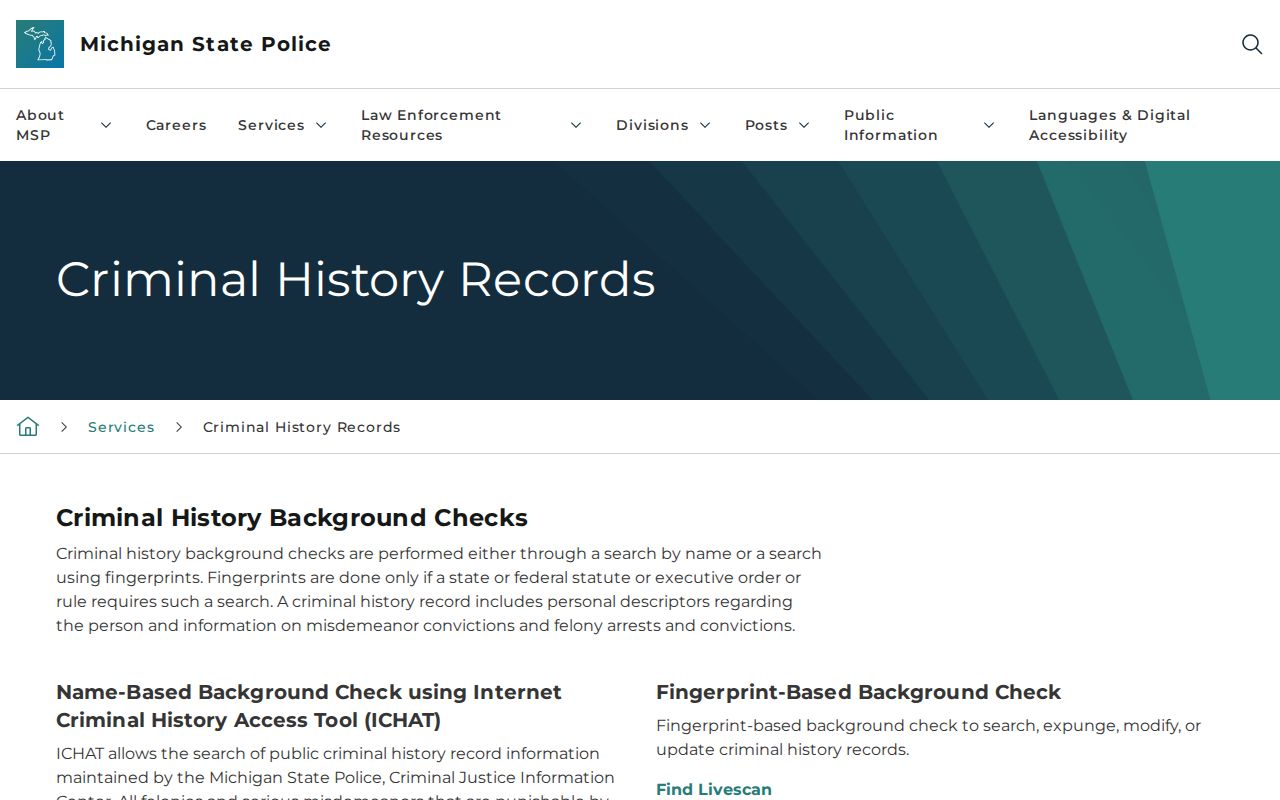
That official explanation helps separate the ICHAT public product from a fingerprint-confirmed review of one’s own record.
Alger County also publishes a $15 sheriff fingerprinting charge. Call the Sheriff’s Department at 906-387-4444 to confirm an appointment before traveling. That local charge covers fingerprinting, not MSP processing. Statutory electronic checks use the proper RI-030 form and an MSP-approved Live Scan agency, with state, FBI, and possible vendor fees set by that channel.
The MSP personal review instructions explain the fingerprint package and correction path.
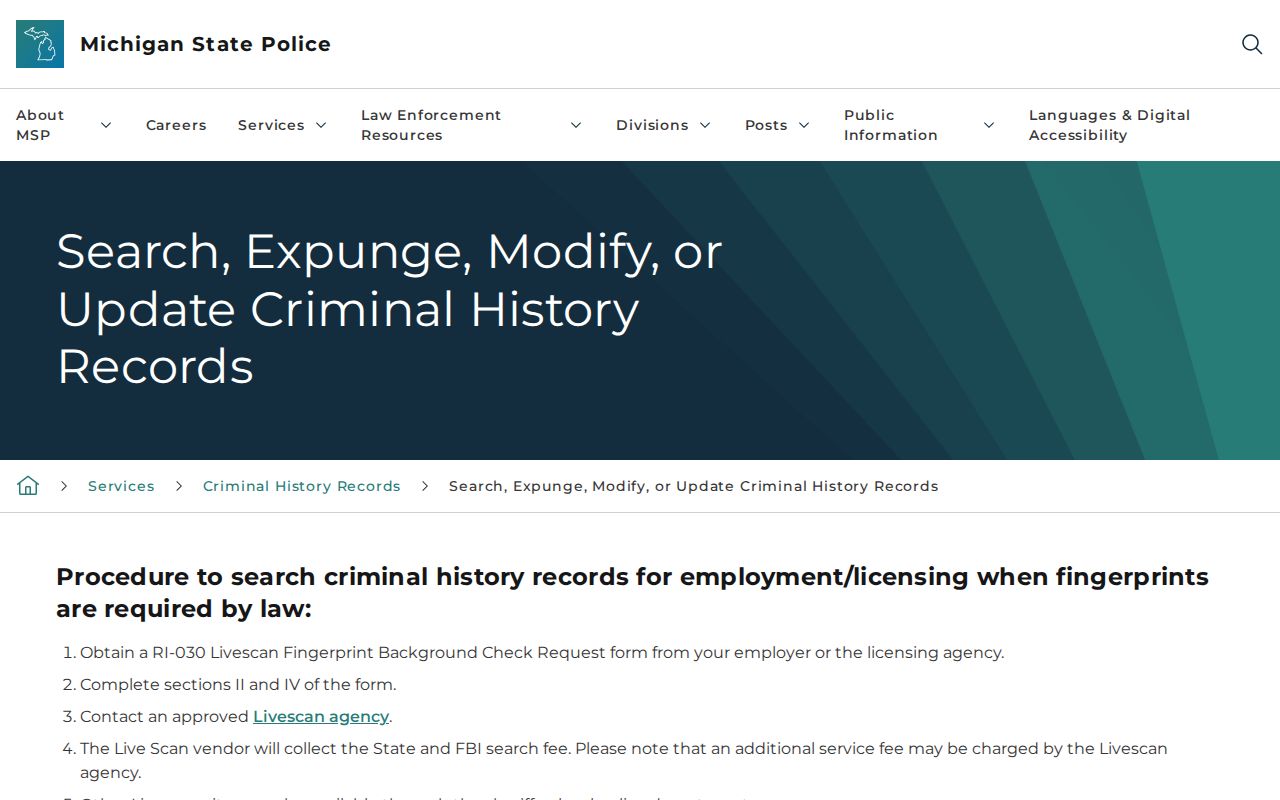
The fingerprint route is the stronger identity match when a name-based Alger County criminal record result seems incomplete or belongs to someone else.
| Product or service | Official amount | What it does |
|---|---|---|
| ICHAT name search | $10 | Returns the public Michigan repository view. |
| MSP personal review | $30 | Uses fingerprints for an identity-confirmed personal record. |
| Extra MSP original | $1 each | Adds another certified or notarized original. |
| Alger Sheriff fingerprints | $15 | Provides local fingerprint service by confirmed appointment. |
| Live Scan | Variable | Uses statutory state and FBI processing plus possible vendor fees. |
ICHAT and Alger County Gaps
ICHAT includes reported felony arrests and convictions plus serious-misdemeanor convictions punishable by more than 93 days. It does not show warrants, federal or tribal matters, traffic cases, juvenile records, other-state history, suppressed matters, or local misdemeanors. A “no record” response therefore does not prove that no arrest, court case, or restricted record exists.
The search asks for a legal first and last name, exact date of birth, sex or gender, and race. Alternate names may need separate searches. Spelling and identity details matter because it is a name-based product. Use checkout to complete the $10 search, then compare any entry with the Alger County court file and final judgment.
| ICHAT field | Use | Search note |
|---|---|---|
| First and last name | Required | Use the legal spelling and search known aliases apart. |
| Date of birth | Required | An exact date helps reduce a mistaken match. |
| Sex or gender | Required | Choose from the current portal options. |
| Race | Required in MSP workflow | Use the current portal options. |
| Search and checkout | Required to finish | The public name search costs $10. |
When the disposition is wrong, start with the sentencing court. The court can correct its record and report the change. MSP provides the RI-027 Judicial Correction Worksheet when the court cannot send an electronic update.
Kinds of Criminal Records
Each Alger County criminal record answers a different question. An incident report describes the event and the officer’s observations. An arrest report records the custody decision. A booking file documents intake at the county jail. The prosecutor’s complaint identifies the charge actually filed, which can differ from the officer’s first allegation.
- District case file: misdemeanor proceedings and the preliminary part of a felony.
- Circuit case file: a felony after bindover, including plea or trial, judgment, and sentence.
- Repository history: fingerprint and name-linked events reported to MSP, with ICHAT showing only its public part.
- Warrant record: a court and law-enforcement record that ICHAT does not disclose.
- Custody or supervision record: sheriff jail data, local probation information, or MDOC and OTIS data.
Michigan PSOR is another narrow record type. It publishes qualifying registration data for public safety, not a complete Alger County criminal history. Juvenile, victim, and other protected information may remain nonpublic. Missing data should never be filled with assumptions.
Alger County Custody Records Split
The Alger County Jail and Alger Correctional Facility are not the same place. The sheriff’s jail at 101 E. Varnum Street holds local detainees and creates county booking records. No official online county roster, booking feed, dedicated inmate line, or jail app was found. Call 906-387-4444 with the person’s full name and approximate booking date, then ask about current custody, transfer, bond information, and the request route for a booking file.
OTIS covers MDOC prisoners, parolees, and felony probationers. It does not cover a person held only in Alger County Jail, someone convicted but not yet sentenced, or every person ever convicted. The MDOC OTIS page states those scope limits.
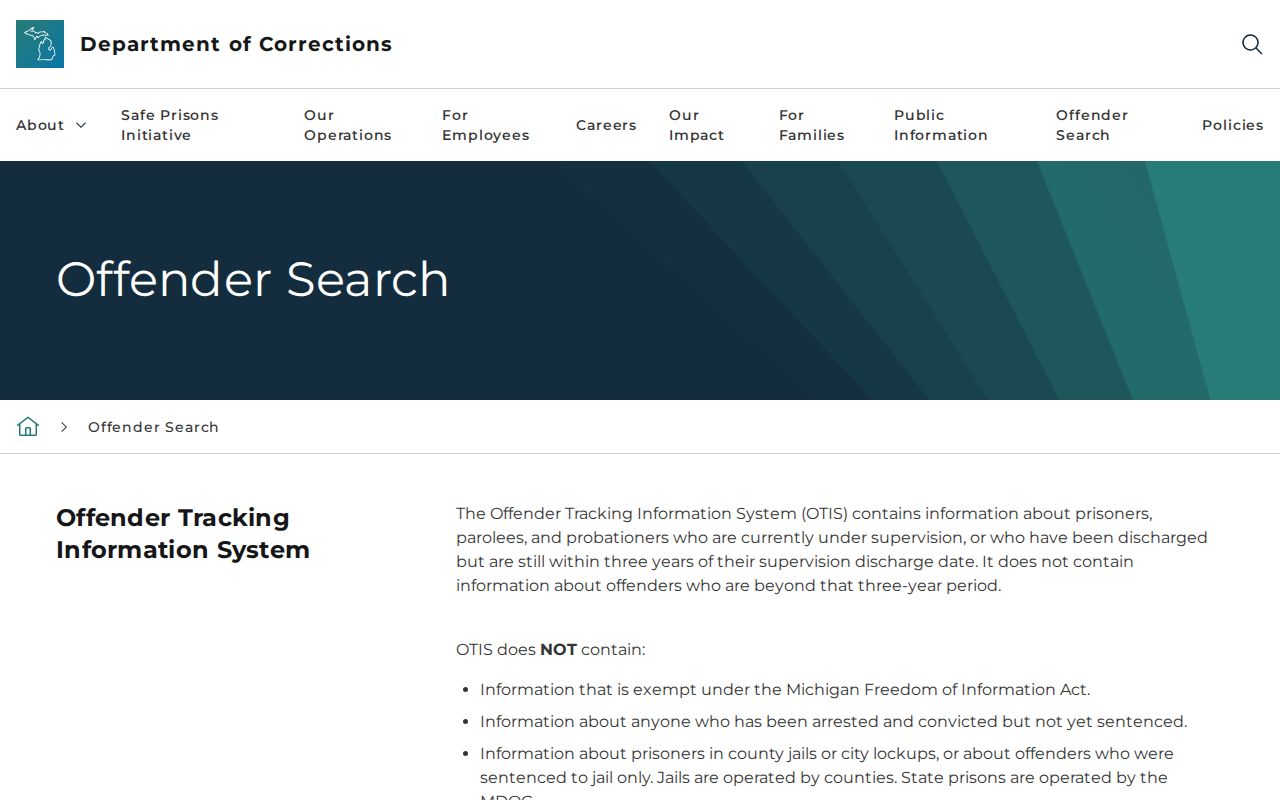
The OTIS scope notice is a key check against treating a missing state profile as proof that no local jail record exists.
Alger Correctional Facility is an MDOC Level II and IV state prison at N6141 Industrial Park Drive. It opened in 1990 and has six housing units. Its records and prisoner lookup route through MDOC, not the Alger County Sheriff. The distinction matters most when a Munising address makes the two facilities seem linked.
The official Alger Correctional Facility profile identifies the prison’s state role and operations.
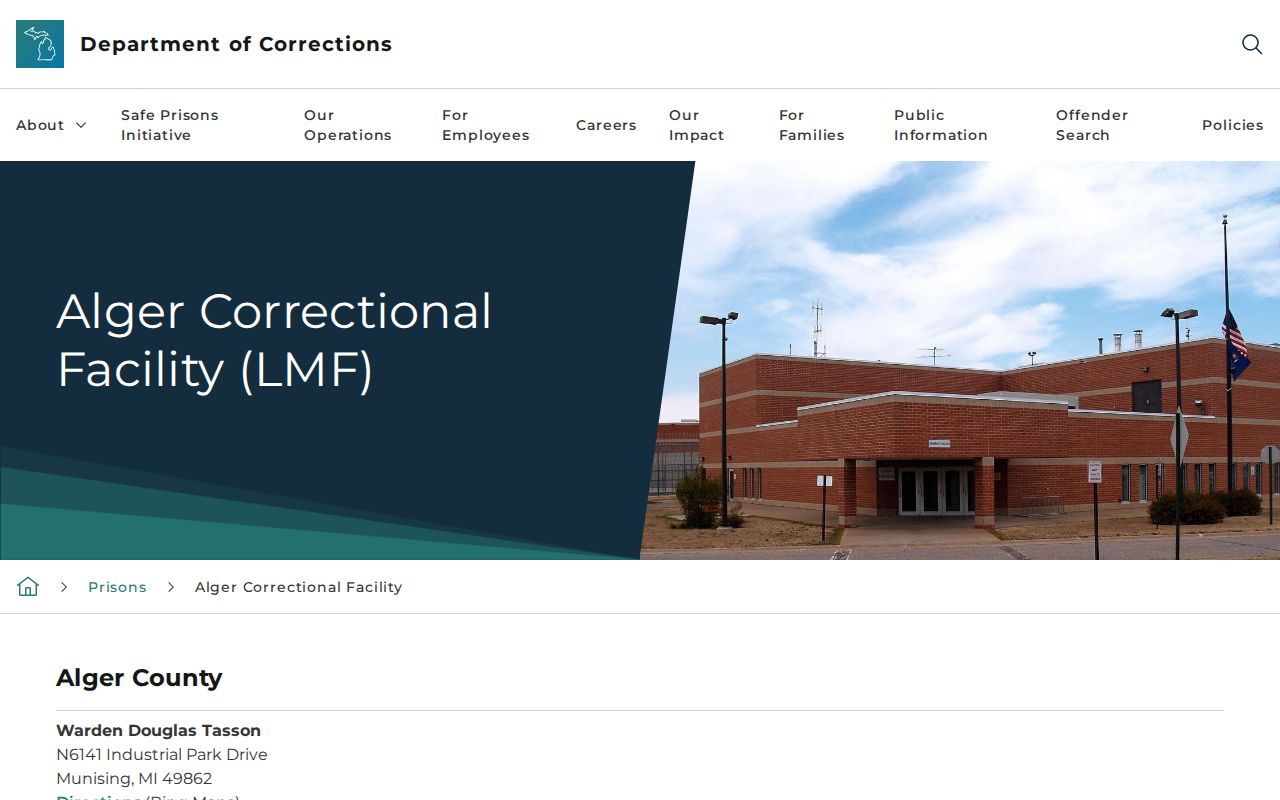
The facility image anchors a useful local distinction: state prison data belongs in OTIS, while county booking data stays with the sheriff.
Alger County Criminal Records: What They Contain
A Michigan criminal history can carry names, aliases, date of birth, physical descriptors, fingerprint-linked identifiers, the arresting agency, charges, court tracking, disposition, and sentence or supervision entries. A public court file adds hearings, pleas, bond, financial obligations, filed papers, and judicial orders. A booking record adds intake time, photograph, location, and release or transfer information.
| Name and identifiers | Legal name, aliases, date of birth, descriptors, and permitted state or fingerprint identifiers. |
|---|---|
| Arrest and booking | Agency, event date, booking number, intake, booking charge, bond, and release data when public. |
| Charges and statutes | Initial allegations, filed counts, offense citations, and level as entered by the source. |
| Disposition | Pending, dismissed, acquitted, convicted, or another charge-level outcome. |
| Sentence | Custody, probation, fines, costs, restitution, or other terms in the judgment. |
| Supervision status | Probation, parole, discharge, absconder, or custody status within the publishing system’s scope. |
Read each date and charge in sequence. The arrest charge may change before filing. One count may be dismissed while another ends in conviction. A docket event is not always the signed final order. The judgment and charge-level dispositions give the clearest court answer.
Older Alger County Criminal Files
Alger County was created in 1885, and the courthouse moved from Au Train to Munising in 1901. The historic courthouse burned in November 1978. That break in the county’s record history gives archival searchers a specific question to ask: is the older file active, archived locally, on microfilm, or held by another repository?
The official Alger County history documents the courthouse move and fire.
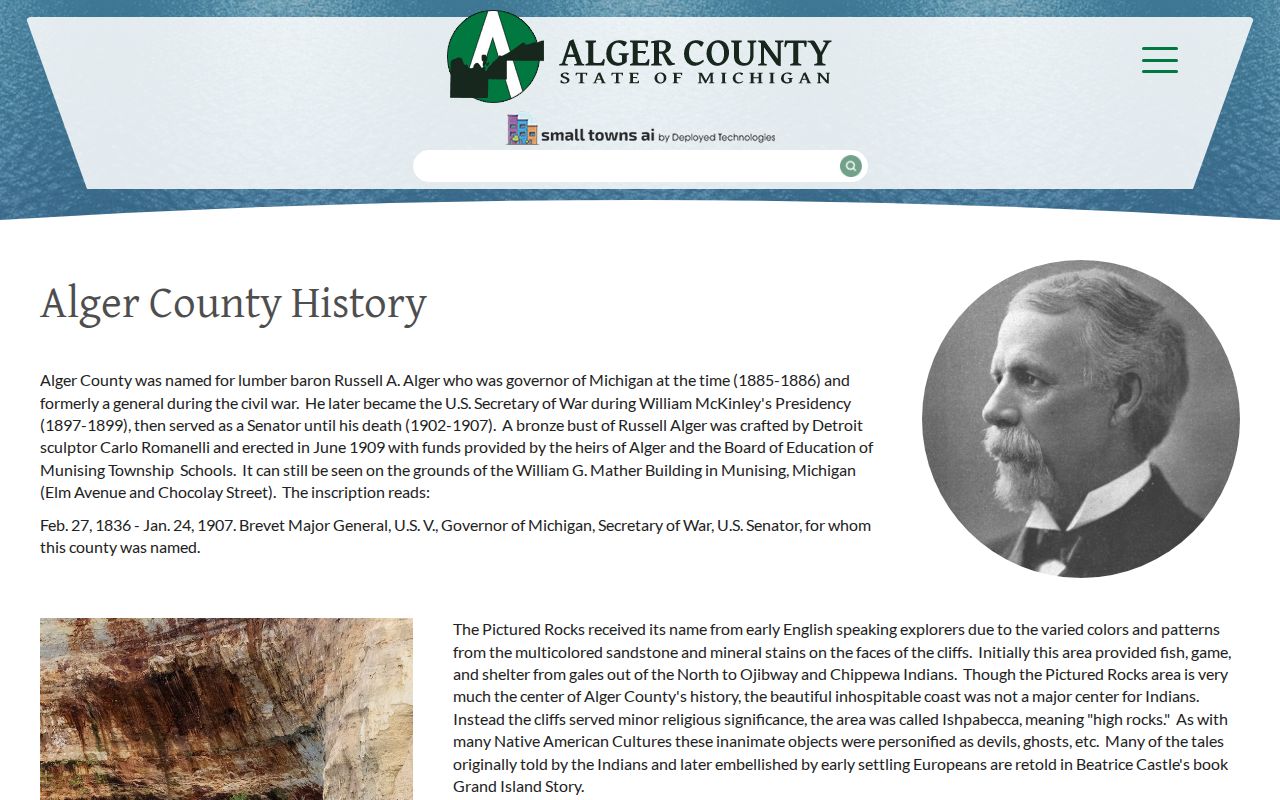
The historic image explains why an absent digital result should lead to an archive question, not a claim that the old Alger County criminal case never existed.
Call the court before a long trip. Ask whether staff can locate the file, whether it is public, what identification or case details they need, and whether a plain or certified copy can be prepared. Current county sources do not publish a criminal-copy fee, so confirm the amount with the clerk rather than relying on a fee from another Michigan court.
Michigan Public Access Laws
Michigan uses two access tracks. Agency reports are requested from the public body under the Michigan Freedom of Information Act. Court case files are inspected under court rules through the clerk. A focused request should describe an existing record by date, location, agency, report number, and format. FOIA does not require an office to create a new report or answer broad questions.
Key laws and rules:
MCL 15.231 sets Michigan’s policy of access to public-body records, subject to exemptions.
MCL 15.235 generally requires a response within five business days and permits one ten-business-day extension.
MCR 8.119 permits inspection of public court records unless law, rule, or order restricts them.
MCL 28.242 supplies Michigan’s criminal identification and repository framework.
Active-investigation details, juvenile records, protected victim information, private identifiers, and LEIN material may be withheld or redacted. Ask for all reasonably separable public portions and a written exemption citation for withheld material. A FOIA response is not always the same as full production; permitted review, redaction, copy, and mailing work may take more time.
Alger County Criminal Warrant Checks
Alger County has no official public active-warrant portal. ICHAT excludes warrants, and LEIN is not open for public name searches. For a criminal bench or arrest warrant, call the 93rd District Court at 906-387-3879 and the sheriff at 906-387-4444. For a circuit felony matter, call Alger County Courts at 906-387-2076 extension 2.
MiCOURT may show a warrant-related docket event, but it is not real-time proof that a warrant remains active. A person trying to resolve their own warrant should contact the issuing court or counsel about appearance, bond, and scheduling. Arriving at a law-enforcement office without first learning the current process does not ensure release.
Friend of the Court offers a separate statewide IVR at 877-543-2660 for bench-warrant information in its own support cases. That channel does not replace the court and sheriff check for general Alger County criminal warrants. Public fields, when released, may include the name, case number, warrant type, issue date, charge or reason, issuing court, bond, and status.
Restricted, Sealed & Expunged Records
Michigan restricts juvenile material, private personal identifiers, victim information, and records made nonpublic by law or court order. ICHAT also omits suppressed matters, local misdemeanors, warrants, traffic, federal, tribal, and out-of-state records. PSOR does not publish victim information or adjudicated juveniles. A blank public search can have many lawful causes.
Michigan calls conviction relief a set-aside or expungement. Application-based relief starts in the court of conviction. An Alger County misdemeanor application goes to the 93rd District Court, while a felony application generally goes to the 11th Circuit. Eligibility depends on the exact conviction, number and grouping of convictions, waiting period, and statutory exclusions.
- Get the judgment and full case history from the convicting court.
- Check what remains through ICHAT, a fingerprint review, or the court.
- Use current SCAO set-aside forms and follow their fingerprint and service directions.
- File in the convicting court and attend a hearing if one is set.
- Confirm the order was sent, then recheck the public record after processing.
Michigan Clean Slate law also provides automatic set-asides for qualifying convictions. Automatic relief is not proof that every eligible-looking record has already disappeared. MSP advises checking ICHAT, ordering a fingerprint review, or contacting the conviction court to learn what remains.
Alger County Supervision Records
Misdemeanor and felony supervision split at the local and state levels. The 93rd District Court handles local misdemeanor probation and lists a probation officer through its public court number. MDOC Field Operations supervises felony probationers and parolees. Alger County belongs to MDOC Region 1, and OTIS can show certain current records plus records for up to three years after discharge.
The MDOC field-office directory is the official route to the Region 1 office listing.
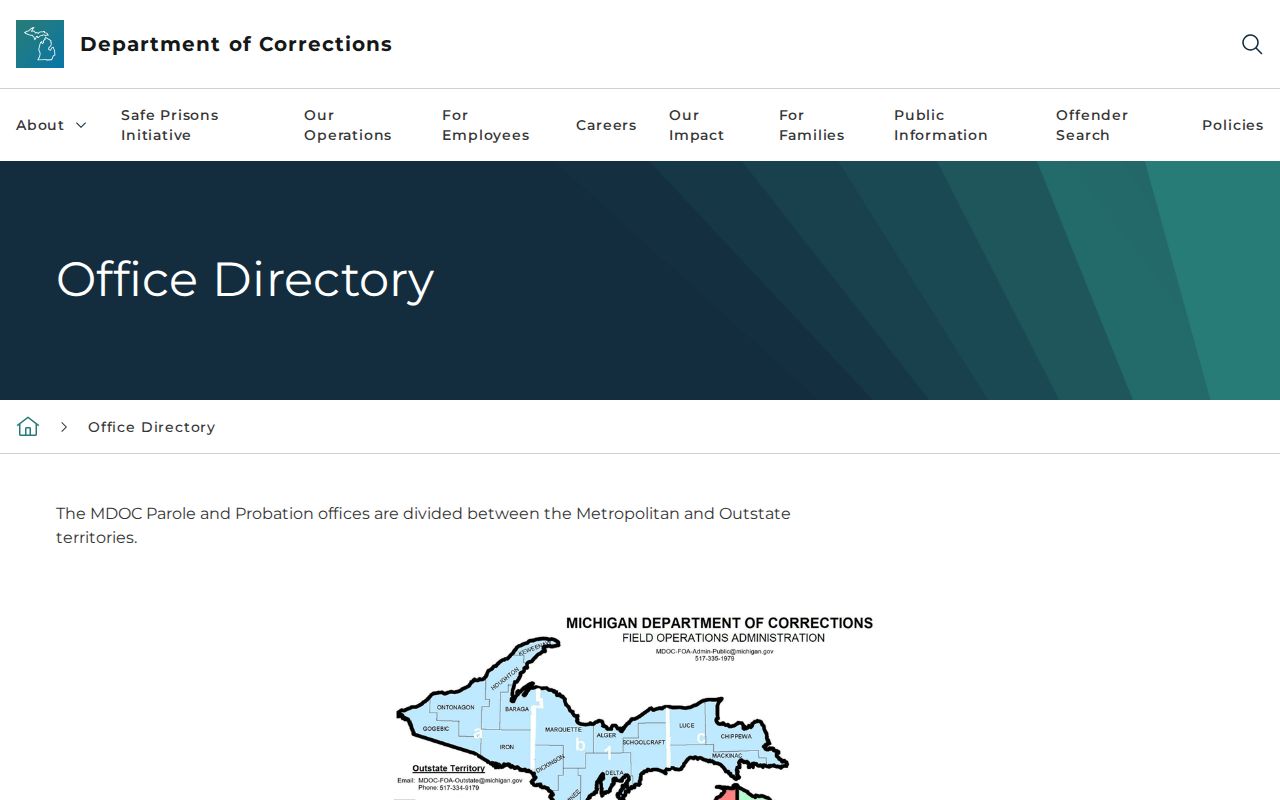
The regional map helps a searcher move from an OTIS supervision location to the correct MDOC contact without confusing it with district probation.
Search OTIS by MDOC number or name. Read supervision location, status, offense, sentence, earliest release, and maximum discharge in context. Confirm a misdemeanor probation term with the 93rd District Court. Confirm a felony sentence in the 11th Circuit file and through OTIS or the listed MDOC office.
- Probation
- Court-ordered supervision in the community instead of or after confinement.
- Parole
- Supervised release from state prison under the Michigan Parole Board’s authority.
- Absconder
- A supervision status used when a person’s whereabouts are unknown after leaving required contact.
- Discharged
- A status showing that the published custody or supervision term has ended.
The Michigan Parole Board page explains the board’s state-prison release role.
The board page separates a parole decision from the county court judgment and the field office that provides day-to-day supervision.
City-by-City Criminal Records in Alger County
Munising is Alger County’s only incorporated city. Its police department creates city incident and arrest reports, while the City of Munising FOIA forms provide the public request route. Munising has no separate municipal court. City misdemeanors, civil infractions, and felony preliminary proceedings go through the 93rd District Court, with qualifying felonies moving to the 11th Circuit.
Munising Record Check
2020 population 1,986 · City police reports use Munising FOIA, while court and booking records route to Alger County offices.
A Munising arrest can therefore create records at City Hall, the sheriff’s jail, and the county courthouse. If MSP, DNR conservation officers, federal park officers, or another agency made the arrest, the incident report remains with that agency even when the booking and court activity took place in Munising.
Alger County Criminal Data Context
Alger County spans 915.03 square miles but had a 2025 population estimate of 8,641. The 2020 census counted 8,842 residents, or about 9.7 people per square mile. Long trips, winter weather, and dispersed communities make a call before visiting the courthouse or sheriff especially useful. Confirm that a file is public and ready, learn its format, and ask about copy costs before travel.
Several agencies work in this Lake Superior county. Munising Police, the Alger County Sheriff, MSP, DNR conservation officers, and federal park personnel can create different records within overlapping areas. Do not add their crime totals as though every agency reports the same place. Use a named agency and year, show raw counts, and be careful with rates because a small change can look large in a small population.
The FBI Crime Data Explorer lets readers select a specific reporting agency and year.
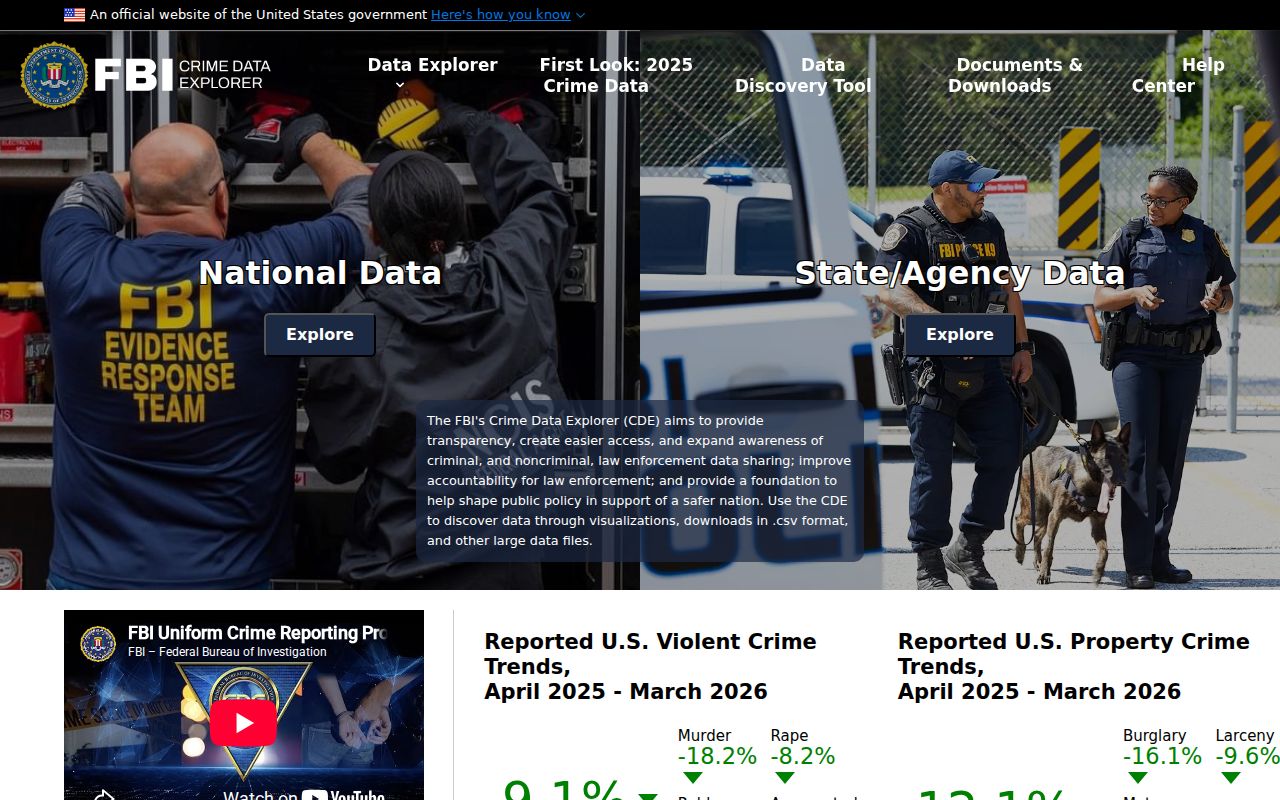
The agency search reinforces the right comparison: Munising Police data, sheriff data, and state or federal activity should stay clearly labeled and separate.
No stable, current county-wide UCR table was found in the reviewed official sources. That gap is better left open than filled with a merged rate that hides agency coverage. The same rule applies across Alger County criminal records: identify the office, the date, and the system before drawing a conclusion.